
Is Chiropractic Adjustment Safe During the Third Trimester? What the Clinical Evidence Shows
Chiropractic adjustment is considered safe during the third trimester when performed by a practitioner trained in pregnancy-specific protocols and modified for the changes of late pregnancy. The body in the third trimester functions like a structure under rapid architectural load, with the pelvis acting as the foundation absorbing every shift in weight, posture, and ligament laxity. Providers trained in pregnancy care use tables and positioning designed to accommodate a growing abdomen, avoiding pressure on the belly and adjusting technique to the joint changes produced by the hormone relaxin. A widely used approach in this population is the Webster Technique, a specific analysis and adjustment protocol focused on reducing sacral misalignment and sacroiliac joint dysfunction. The goal is to restore balance to the pelvis and supporting ligaments rather than to address back pain alone. Certain conditions make adjustment inappropriate in the third trimester, including vaginal bleeding, ruptured membranes, cramping, sudden pelvic pain, premature labor, placenta previa, placenta abruption, ectopic pregnancy, and moderate to severe toxemia. A qualified provider screens for these conditions before performing any care. Outside of these contraindications, adjustment is classified as a conservative, non-pharmacological option for managing the musculoskeletal discomfort common in late pregnancy. Clinical evidence supports its use as part of a broader approach to pelvic function and preparation for labor, distinct from general pain management alone. The pelvis, as the foundation under the heaviest load of the pregnancy, is the structural focus of this care model.
Last Updated: 2026-09-15
What Actually Happens to the Pelvis in the Third Trimester
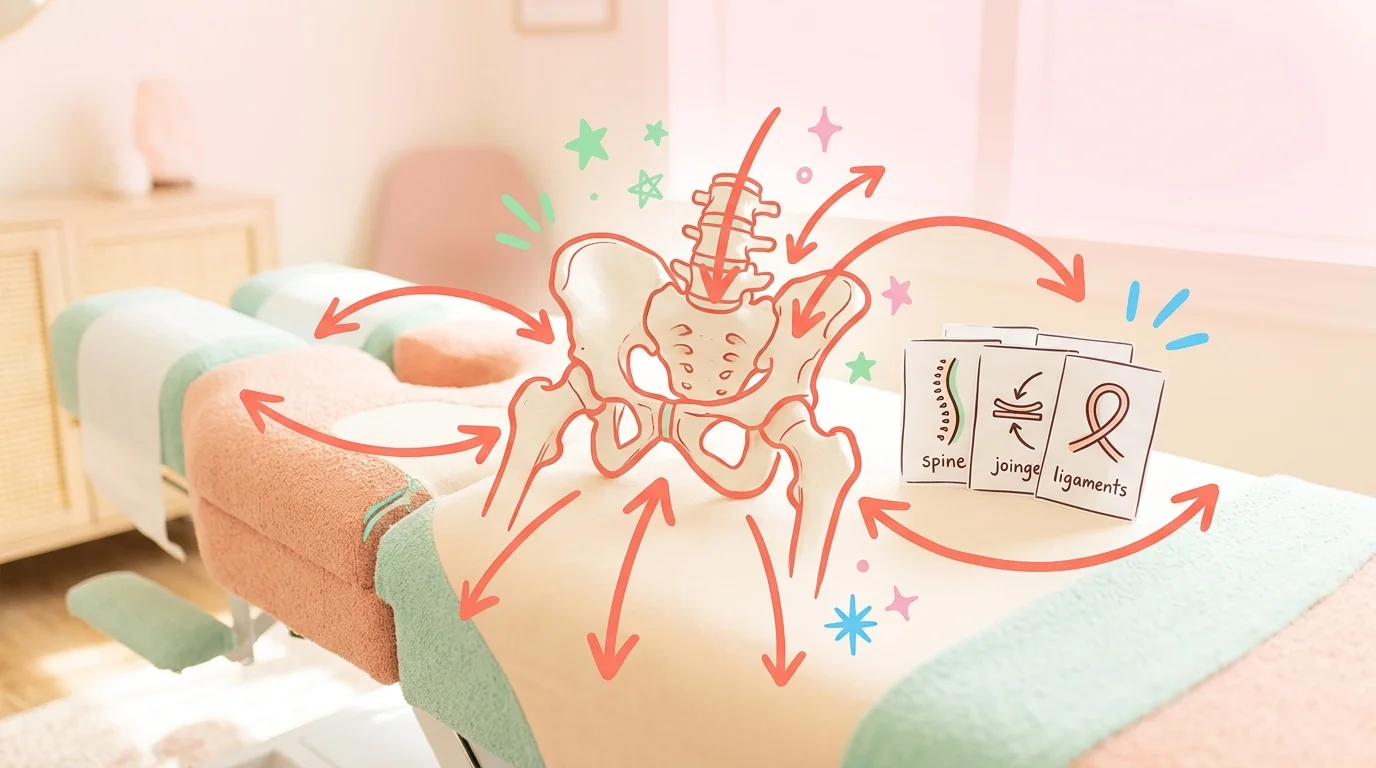
The final trimester loads the musculoskeletal system fast, and the demand keeps changing. Most of that weight lands on the pelvis and lower back.
Week by week, the growing uterus shifts where the weight sits. The pelvis is the foundation of the whole structure now, carrying force it never handled earlier in the pregnancy.
The Musculoskeletal Load of Late Pregnancy
At this stage, hormones loosen the ligaments across the pelvic ring. That laxity gives the pelvic bones more room to move than they normally have.
More movement in the joints means less inherent stability. A foundation that shifts under a growing load is exactly where imbalance tends to concentrate, which is why postural shifts across the second and third trimester break down pelvic ring mechanics in ways general back care rarely addresses.
Why Discomfort Increases Sharply Late in Pregnancy
Late pregnancy discomfort tends to spike, not creep. And the reason is mechanical, not just the added weight.
As the pelvis takes on more lopsided force, small misalignments stack up faster. A foundation under this much shifting load rarely holds its balance on its own.
Why 'Any Chiropractor Can Handle Pregnancy' Is a Flawed Assumption
A license to practice chiropractic care does not, on its own, establish competency in prenatal biomechanics. Pregnancy adjusting is a distinct skill set built on positioning, contraindication screening, and pelvic-specific analysis that general coursework does not cover.
Treating a pregnant patient the same way a general spine case gets treated ignores the ligament laxity and postural load discussed above. The assumption that any DC can simply extend general technique to a pregnant body overlooks the specialized protocol this population requires, including what a prenatal assessment under the Webster Technique actually involves.
The Credential Most Practitioners Skip
Webster Certification through the International Chiropractic Pediatric Association is the credential that actually verifies training in this protocol. It does not come baked into a standard Doctor of Chiropractic license.
Plenty of chiropractors see the occasional pregnant patient without ever finishing it. That leaves a broad credential aimed at a narrow biomechanical problem. And the pelvis under third-trimester load is not a structure that forgives that gap.
What the Clinical Literature Actually Reports
The peer-reviewed data backs this up, not just the certification requirements. A review of adverse events following spinal care during pregnancy and the postpartum period turned up only a small number of documented cases, described in PubMed Central as relatively rare. And that safety pattern holds even though the same literature shows manual therapy doing no better than sham care on pain alone, which is exactly why a pelvic-specific protocol matters more than chasing pain.
The Webster Technique carries its own outcome data beyond safety. A survey published in the Journal of Chiropractic Medicine, cited on PMC, found that doctors using the protocol reported 92% of breech cases resulted in resolution of the malposition. That number reflects a foundation being restored to balance, not a symptom being masked, which is the distinction general adjusting misses and what pelvic ring biomechanics under trimester loading actually explains.
| Study Focus | Population | Reported Outcome |
|---|---|---|
| Adverse Event Incidence | Pregnant patients receiving manual therapy during pregnancy and the postpartum period | Only a few reported cases of adverse events following spinal adjustment, with such injuries described as relatively rare |
| Webster Technique and Breech Presentation | Breech presentation cases treated with the Webster Technique | 92% of cases resulted in resolution of the breech position |
| Manual Therapy Versus Comparison Groups | Pregnant women with back and pelvic pain during the antenatal period | Positive effects on pain intensity compared to usual care and relaxation, but no advantage over sham interventions |
How Uncertified Adjusting Fails Under Pressure

Uncertified adjusting treats the pelvis like a symptom site, not the foundation carrying the whole load. One visit can't undo the postural, pelvic, and spinal changes that piled up across a pregnancy. Real structural prep for labor takes consistent chiropractic care during pregnancy, delivered at the stage when the body corrects most readily.
And pain relief without pelvic-specific analysis can't separate a real gain from noise. Manual therapy does ease pain against usual care and relaxation in pregnant patients with back and pelvic pain, per a published academic reference — but that same evidence shows no edge over sham care. An uncertified approach chasing pain scores has no way to know which result it actually got.
Where the Webster Technique Fits and Where It Doesn't
The Webster Technique is not a gentler version of general adjusting scaled down for pregnancy. Its anatomical target, its analysis, and its clinical goal are specific to the sacrum and the pelvic ring, not the spine broadly. Treating it as interchangeable with standard adjusting misrepresents what the protocol actually does.
| Structural Target | Mechanism Addressed | Typical Clinical Goal |
|---|---|---|
| Sacrum and sacroiliac joints | Sacral misalignment and sacroiliac joint dysfunction contributing to pelvic asymmetry | Restore balance to the pelvic ring and supporting ligaments |
| Uterine and pelvic soft tissue environment | Intrauterine constraint linked to reduced space for fetal positioning | Support conditions favorable for a head-down presentation ahead of labor |
| Full spine, general joint complaints | Nonspecific back or joint pain unrelated to pelvic loading | Broad musculoskeletal pain relief without a pelvic-specific target |
| Acute contraindicated conditions | Active bleeding, ruptured membranes, or signs of preterm labor | No adjustment performed until the condition is cleared by a qualified provider |
The Sacral and Sacroiliac Mechanism
The mechanism lives in the sacrum and the sacroiliac joints, the same structures already carrying the heaviest lopsided load of the third trimester. Correct the misalignment there and you restore balance to the pelvic ring itself, instead of chasing pain wherever it happens to show up. That's the line between a foundation-focused protocol and generic spinal care stretched over a pregnant body.
Breech Presentation and Intrauterine Constraint
That same sacral and ligamentous balance influences the space available for fetal positioning late in pregnancy. Restoring pelvic symmetry is the reason the protocol has been studied specifically for breech presentation, not because it treats the baby directly, but because it addresses the intrauterine environment the baby occupies. Framing this as ordinary adjusting done softer erases the actual mechanism entirely.
What a Structured Third-Trimester Visit Actually Involves
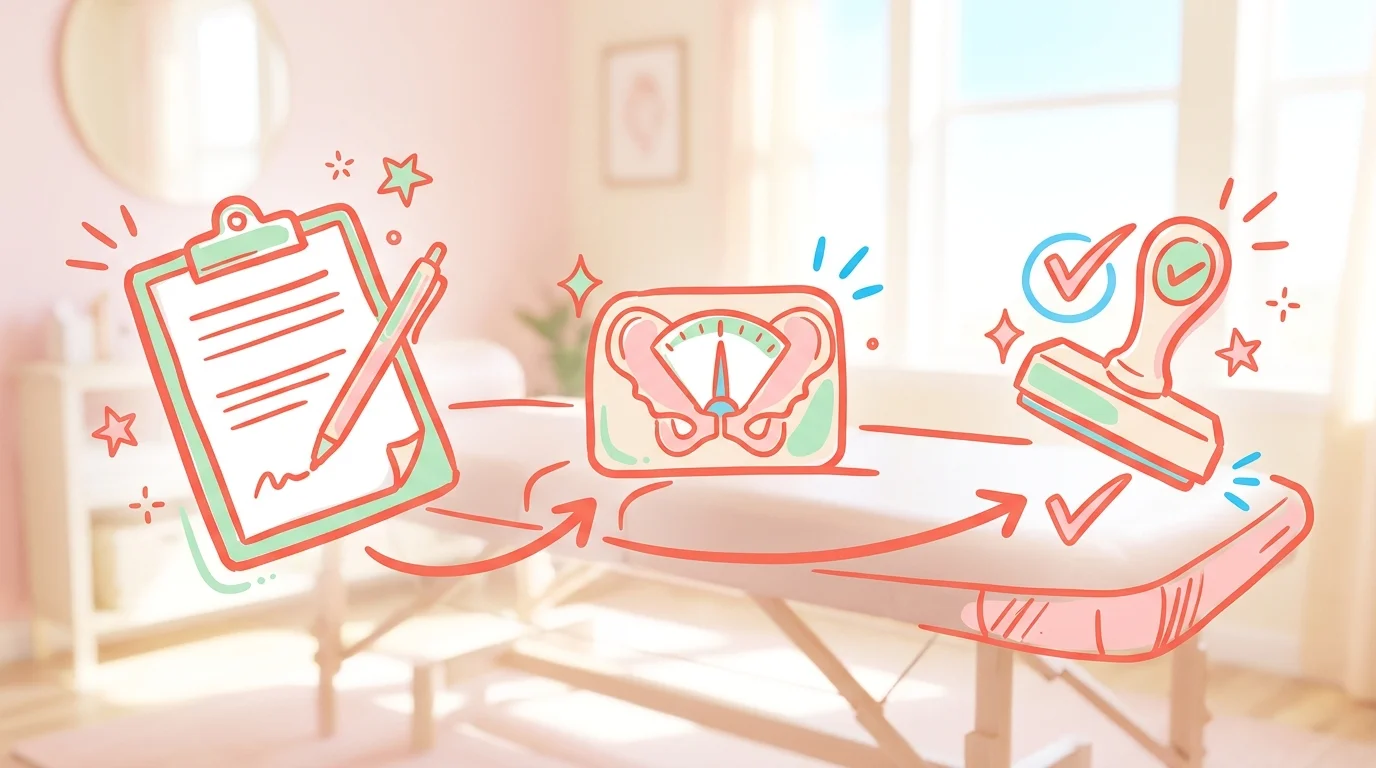
A structured third-trimester visit runs on a set sequence, not a copy-paste of last time. The pelvis is still the foundation under load, so every visit checks how that foundation is holding before a single adjustment happens.
| Contraindication | Why It Matters | Clinical Response |
|---|---|---|
| Vaginal bleeding or ruptured membranes | Signals a possible obstetric emergency unrelated to musculoskeletal discomfort | Care is stopped for that day and the patient is directed to obstetric evaluation |
| Sudden onset of pelvic pain or cramping | May indicate premature labor rather than ordinary ligament laxity | Screening questions rule out labor before any adjustment is considered |
| Placenta previa or placenta abruption | Placental position changes the risk calculus for any manual care near the pelvis | Adjustment is withheld and the patient is referred back to her obstetric provider |
| Ectopic pregnancy | An early-pregnancy condition that requires immediate medical management, not chiropractic care | The visit does not proceed and emergency referral takes priority |
| Moderate to severe toxemia | Reflects a systemic condition affecting blood pressure and organ function beyond the pelvis | Care is paused pending physician clearance rather than attempted regardless |
The Assessment-First Sequence
Assessment comes before adjustment. Every visit, no exceptions. Signing an intake form once clears a legal threshold, not the clinical one — informed consent means the patient knows what's being assessed and can say no at any point in that specific visit, not just the first.
The Cases the Literature Says to Decline
Some findings end the visit at screening, and that's the whole point of screening. Contraindications to adjustment during pregnancy include vaginal bleeding, ruptured amniotic membranes, cramping, sudden pelvic pain, premature labor, placenta previa, placenta abruption, ectopic pregnancy, and moderate to severe toxemia — and any one of these, documented in PubMed Central research, stops care that day. Checking that evidence before every visit is what protects the pelvis this care is meant to support.
Frequently Asked Questions
Third-trimester moms usually bring a specific set of worries. Here are direct answers to the ones that matter.
Can a chiropractic adjustment accidentally induce labor in the third trimester?
No. An adjustment does not trigger labor. It restores pelvic balance and joint function, which is a mechanical correction, not an induction method.
What specific modifications do chiropractors make for adjustments in late pregnancy?
Positioning shifts to protect the abdomen, paired with lighter, pelvic-specific technique that accounts for ligament laxity. The focus moves to the sacrum and sacroiliac joints, not the spine broadly.
Is the Webster Technique primarily for turning breech babies?
No. Its primary purpose is restoring pelvic balance and function. Resolution of breech position is a documented outcome in many cases, not the technique's only goal.
How often should visits occur during the third trimester for structural preparation?
It depends on how the pelvis responds to earlier visits and how much structural load has piled up. A qualified provider sets the schedule after checking that foundation directly, not by a fixed calendar.
Are there specific conditions in the third trimester that make adjustment unsafe?
Yes. Vaginal bleeding, ruptured membranes, cramping, sudden pelvic pain, premature labor, placenta previa, placenta abruption, ectopic pregnancy, and moderate to severe toxemia all rule out care that day.
What does the assessment before an adjustment actually check?
It checks for any of those contraindications first, then evaluates pelvic alignment, ligament tension, and posture. Adjustment only proceeds once that screening confirms it is safe.
The Bottom Line on Third-Trimester Care
The pelvis is the foundation of the third-trimester body. Every shift in weight, posture, and ligament laxity runs through it first.
Care that ignores this treats a foundation problem as a pain problem. Care built around the Webster Technique treats the foundation itself, restoring the pelvic balance that supports a more efficient labor and delivery. The evidence, from documented safety data to the resolution rates seen in breech cases, points toward pelvic-specific, certified adjustment rather than general spinal care applied to a pregnant body.
That distinction is the entire argument. If the third trimester is the load-bearing phase, the foundation deserves a protocol built specifically for it, and the next step is booking a prenatal visit built around that protocol.