
Inside Dr. Aimee's Webster Technique Protocol: What to Expect During Your Prenatal Assessment in Huntington Beach
A Webster Technique prenatal assessment is a structured chiropractic evaluation that checks pelvic alignment, sacral position, and the tension of the ligaments supporting the uterus during pregnancy. The assessment begins with a review of posture and gait, since a shifting center of gravity changes how weight moves through the hips and low back. The practitioner then palpates the sacrum and pelvis to identify areas of restriction or asymmetry, noting how the joints on each side are moving relative to one another. Ligament tension is checked next, because tightness in the round ligaments or other supporting structures can influence uterine position and pelvic balance. Muscle tone across the hips and pelvic floor is also evaluated, since imbalanced muscle pull can pull the pelvis out of its neutral position. Each finding from this assessment informs the specific adjustment technique used, rather than applying a generic approach to every pregnant patient. The purpose of restoring pelvic and sacral balance is to reduce nervous system interference and biomechanical stress on the structures surrounding the uterus. This is intended to support more comfortable movement throughout pregnancy and to allow the body to function as designed as it prepares for labor. The assessment is repeated at subsequent visits to track changes in alignment and ligament tension over the course of pregnancy. Because the pelvis continues adapting as the pregnancy progresses, this ongoing evaluation allows care to be adjusted to what the body needs at each stage rather than following a fixed protocol regardless of how the body is changing.
Last Updated: 2026-09-15
What the Webster Technique Actually Assesses (And Why That's Different From an Adjustment)

The Webster Technique isn't a generic prenatal adjustment. It's a specialized chiropractic protocol built for the pregnant body, addressing sacral misalignment and the ligament tension around a shifting pelvis. As hormones change and your center of gravity moves, real stress lands on the pelvis and sacrum, and that stress is exactly what the assessment in this clinical guide to pelvic balance and sacral alignment is built to track.
Why 'Any Chiropractor Can Handle This' Falls Apart Under the Certification Standard
A license tells you someone can adjust a spine. It says nothing about reading a pregnant pelvis — that skill comes only from the ICPA's dedicated Webster training, which most chiropractors never pursue.
Walking Through the Assessment: Sacral Alignment, Ligament Tension, and Pelvic Balance
| Assessment Step | What It Analyzes | Why It Matters for Pelvic Balance |
|---|---|---|
| Posture and Gait Review | How weight shifts through the hips and low back as the center of gravity moves forward | Establishes a baseline for where mechanical stress is concentrating before deeper palpation begins |
| Sacral Position Check | Alignment and motion of the sacrum relative to the pelvic bones on each side | Identifies restriction or asymmetry that changes how load transfers through the pelvis with movement |
| Ligament Tension Analysis | Tightness in the round ligaments and other structures supporting the uterus | Uneven ligament tension can pull the uterus out of a neutral position and add to sacral stress |
| Pelvic Floor and Hip Muscle Tone | Balance of muscle pull across the hips and pelvic floor | Imbalanced muscle tone can drag the pelvis out of neutral, compounding restriction found at the sacrum |
| Adjustment Selection | Which specific technique matches the findings from the steps above | Ensures care responds to this body's actual pattern instead of applying one fixed adjustment to everyone |
Step One: Sacral and Pelvic Alignment Analysis
Sacral alignment analysis starts here: the practitioner checks how the sacrum sits between the pelvic bones. Restriction on one side changes how weight moves through the hips with every step. That imbalance is exactly what the assessment is built to catch before it grows.
Step Two: Evaluating Ligament and Soft Tissue Tension
Ligament and soft tissue tension get checked next, since tight round ligaments can pull the uterus out of a neutral position. Muscle tone across the hips and pelvic floor factors in here too. Uneven pull in these structures compounds the sacral stress the pregnant body is already managing. Some practitioners lean on soft tissue work alone to chase relief, which is a mismatch this review of third-trimester adjustment evidence addresses directly. Restoring balance to the ligaments and the sacrum together is what actually supports the body's function heading into labor.
Where a Single-Visit Mindset Breaks Down Against a Changing Pelvis
One appointment cannot undo what months of a shifting load have done to the pelvis. Pregnancy-related pelvic girdle pain showed a point-prevalence of 44% in a large sample of Australian women, evidence that this is a cumulative condition rather than a single moment of strain, as documented in this PubMed Central analysis. A structure under a changing load needs its assessment repeated as that load keeps changing, which is why why home stretching cannot correct a misaligned sacrum walks through the same limitation from a different angle. Structural preparation for birth requires consistent care at the stage where the body is most responsive, not a single visit treated as complete. That responsiveness cuts both ways. Given the coagulability status of pregnant and postpartum women and their hormonal and biomechanical changes, some care decisions have to be made session by session, a caution reflected in this PMC review of adjustment safety during pregnancy.
What the Research Says About Chiropractic Care During Pregnancy
| Finding | Population Studied | Clinical Relevance |
|---|---|---|
| Pregnancy-related pelvic girdle pain prevalence | Australian pregnant women, large random sample | Confirms pelvic girdle pain is a widespread, cumulative condition rather than an isolated complaint |
| Serious adverse events from spinal manipulation | Pregnant patients across available published reports | Supports the position that adjustment carries a very rare serious-event profile, though rigorous study remains limited |
| Best-practice recommendations for back and pelvic girdle pain | Pregnant and postpartum patients evaluated by a multidisciplinary steering committee | Establishes that structured chiropractic care fits within a cross-discipline standard of practice, not an isolated approach |
| Contraindication risk tied to coagulability and biomechanical change | Pregnant and postpartum populations | Explains why some care decisions must account for hormonal and biomechanical shifts rather than following a fixed protocol |
Reading the Evidence on Safety and Prevalence
Serious adverse events from spinal adjustment during pregnancy are very rare. But the rigorous research is still thin, a gap National Institutes of Health findings name openly. That's exactly why the assessment tracks changes at every visit, instead of assuming one snapshot tells the whole story.
Where Chiropractic Care Fits Alongside Obstetric Care
A structured, ongoing approach isn't a solo chiropractic invention. A multidisciplinary steering committee, including obstetricians and a physical medicine and rehabilitation practitioner, built best-practice recommendations for pregnant and postpartum patients in this published research data. That kind of cross-discipline thinking is what Webster-Certified prenatal care is built around.
How the Assessment Findings Shape a Care Timeline
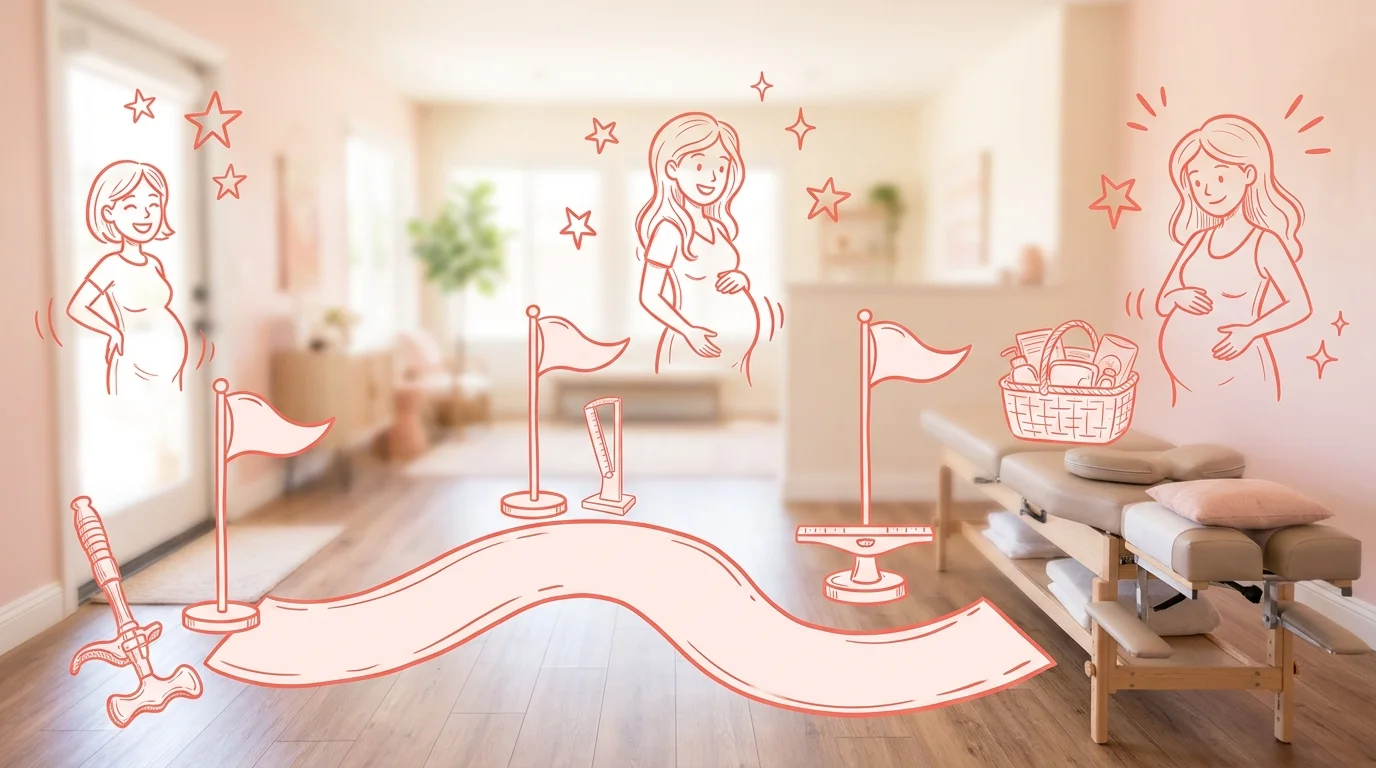
Findings translate straight into visit cadence, so cross-disciplinary care never hands every patient the same schedule. A preset visit count answers the calendar's question, not the body's. At 12 weeks the pelvis is just starting to shift; at 36 weeks it has been carrying accumulated load for months. Those are two different assessments entirely.
| Trimester | Common Presentation | Typical Focus of Care |
|---|---|---|
| First Trimester | Early postural shifts, mild sacral asymmetry, and general ligament adjustment as the pelvis begins responding to hormonal changes | Establishing baseline alignment and monitoring how the pelvis is starting to adapt to a changing center of gravity |
| Second Trimester | Increasing round ligament tension, moderate pelvic girdle discomfort, and greater asymmetry as the growing uterus shifts weight distribution | Restoring sacral balance more frequently and addressing ligament tension before it compounds into more significant restriction |
| Third Trimester | Advancing structural stress, possible breech presentation, and chronic pelvic or sciatic discomfort as the body prepares for labor | Tighter visit spacing focused on pelvic balance, sacral alignment, and supporting optimal fetal positioning heading into delivery |
| Postpartum | Residual ligament laxity and pelvic misalignment carried over from labor and delivery | Restoring pelvic and sacral function as the body recovers from the structural demands of childbirth |
Matching Visit Frequency to Trimester and Presentation
Trimester and presentation both shape how often you come in. Minor early asymmetry may need only occasional monitoring, while significant sacral restriction near the third trimester calls for tighter spacing. The timeline follows what the assessment finds, never a fixed number set in advance.
Frequently Asked Questions
The steps above leave a few practical questions hanging. Here is where the mechanical ones get answered.
Is the Webster Technique painful or unsafe for the baby?
The adjustment is gentle and specific to the pelvis and sacrum, with no forceful twisting or high-velocity movement. Every bit of pressure stays light, controlled, and adapted to a pregnant body.
How is a Webster Technique assessment different from a regular chiropractic adjustment?
A standard adjustment skips the sacral, ligament, and pelvic checks described above. Webster Certification adds a protocol built around a shifting center of gravity and the ligament tension unique to pregnancy. A general adjustment was never designed to track those changes.
When is the best time during pregnancy to start the Webster Technique?
Start the moment discomfort or asymmetry shows up, even early on. Wait until the third trimester and the sacrum has been compensating for months without a single check. Earlier assessment tracks the load as it builds, instead of scrambling to catch up late.
Does the Webster Technique guarantee my baby will turn from a breech position?
No adjustment can guarantee how a baby positions. The assessment works on pelvic balance and ligament tension, which may support the space a baby needs to turn. Positioning depends on factors the assessment alone does not control.
How many sessions are typically needed to see results from the Webster Technique?
There is no number set ahead of time. Visit cadence follows what each assessment finds, never a standardized count. Mild asymmetry early in pregnancy needs different spacing than advancing structural stress near delivery.
Can I receive Webster Technique care if I am also seeing a high-risk OB-GYN?
Yes. Webster Certified care works alongside a high-risk OB-GYN rather than replacing that oversight. The multidisciplinary approach referenced earlier reflects exactly this kind of coordinated care. Communication between providers keeps the assessment aligned with any medical restrictions already in place.
Where This Leaves You
The pregnant pelvis is a structure carrying a load that shifts week by week. Every ligament, joint, and muscle in that assessment is adapting in real time. None of it is sitting still, waiting for delivery day.
So a single adjustment was never the goal. Assessment first, adjustment second, reassessment at every visit after that. That is what a protocol built for the pregnant body looks like, and it is why Webster Certification matters more than a general chiropractic license ever could.
A pelvis under changing load deserves care that changes with it. If you are ready to have your own alignment, sacral position, and ligament tension assessed by someone trained specifically for this work, talk it through with us.