
Why Prenatal Yoga and Home Exercises Can't Fix a Structurally Misaligned Sacrum
Prenatal yoga and home exercises cannot fix a structurally misaligned sacrum because they act on muscle tissue, not on the joint itself. A misaligned sacrum is a biomechanical problem at the base of the spine, where it meets the pelvis. It is not a muscular one. Stretching and gentle movement lengthen tight muscles and soften the surrounding soft tissue. But they have no mechanical way to reposition a joint that has shifted out of proper alignment. The pelvis works as a load-bearing joint system, much like a door hung on a hinge. Muscular work can soften the door and ease the pull of muscles fighting a misaligned frame. It cannot realign the hinge the door depends on. Correcting that hinge takes a specific structural adjustment that can assess joint position and restore proper motion, not just reduce surface tension. This is why many pregnant women who follow a steady stretching or yoga routine still feel pelvic pain that lingers or returns. The muscular tension eases for a while, but the underlying joint dysfunction stays unaddressed, so the tightness and discomfort rebuild around it. Hormonal changes during pregnancy also increase ligament laxity around the pelvis, which can let the sacrum shift out of its normal position more easily and further limit what muscular approaches alone can do. A structural adjustment targets the joint mechanics directly, evaluating how the sacrum moves relative to the pelvis and repositioning it accordingly. Addressing the joint, rather than only the muscles around it, is what separates lasting resolution of pelvic misalignment from temporary symptom relief.
Last Updated: 2026-09-15
Why the Same Stretch Routine Gets Different Results for Different Pain
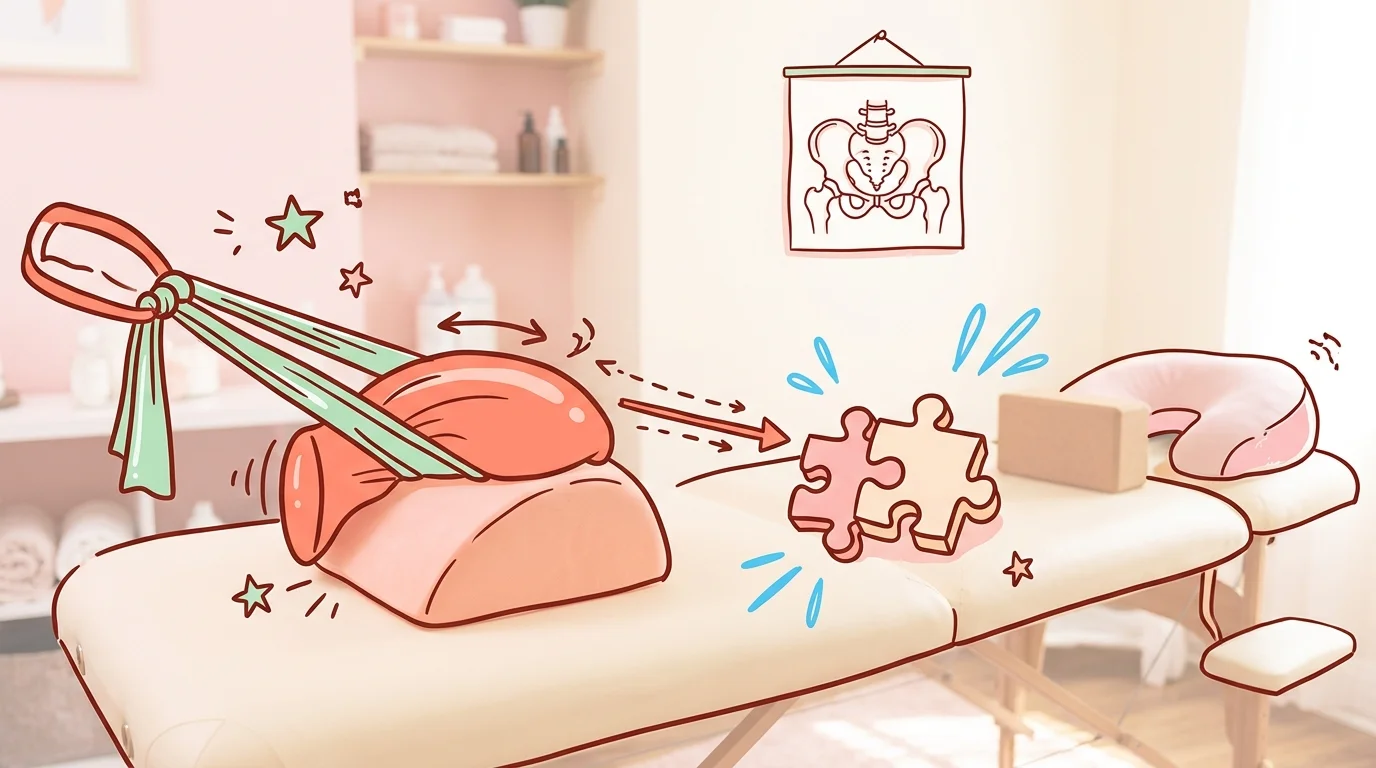
Not all prenatal pain comes from the same source. Two categories exist, and they respond to entirely different kinds of care. One is muscular tightness caused by shifting posture and growing weight. The other is joint dysfunction at the sacrum itself.
When you're pregnant, well-meaning advice floods in from every direction. Gentle stretching and prenatal yoga sit right at the top of that list for aches and pains. And that advice works beautifully for one category of pain while doing nothing at all for the other.
Muscular Pain Versus Joint Dysfunction
Muscular pain answers to muscular remedies because the tissue is the problem. A structurally misaligned sacrum is a different animal. It's a biomechanical joint issue at the base of the spine, not a muscle waiting to be loosened.
Exercise can absolutely calm the muscular tension that builds up around a misaligned joint. What it cannot do is physically reposition the sacroiliac joint itself. That's why the same routine can produce opposite results depending on which category of pain a woman actually has, a difference our clinical guide to sacral alignment during pregnancy walks through in more detail.
Where the General Advice Comes From
General prenatal advice is built for the muscular category, because that's the more common complaint. It isn't wrong advice. It's just incomplete when the real problem is a joint.
Plenty of mothers follow that advice to the letter, yet the deep, structural pelvic pain persists or even worsens. That's not a failure of effort. It's a mismatch between the care applied and where the pain actually comes from.
Why Stretching and Home Exercise Hit a Structural Ceiling
Muscular pain and joint dysfunction can feel like the same ache. But the tissue behind each one behaves differently under pressure. Soft tissue work and stretching can soften the muscles pulling against a misaligned pelvis, yet neither one reaches the fascia binding the sacroiliac joint itself.
| Modality | What It Targets | Why It Stalls at the Joint |
|---|---|---|
| Prenatal Yoga | Surrounding muscle groups and general flexibility | Lengthens tight muscle without ever contacting the sacroiliac joint's shifted position |
| Home Stretching Routines | Surface muscle tension and short-term range of motion | Lacks the sustained mechanical stress needed to influence deeper fascial tissue around the joint |
| Gentle Soft Tissue Work | Muscle guarding and localized tension patterns | Eases the door without ever reaching the hinge, leaving joint position unchanged |
| Structural Chiropractic Adjustment | The sacroiliac joint itself and its position relative to the pelvis | Assesses and corrects joint mechanics directly, which muscular approaches have no pathway to reach |
The Fascia Problem Stretching Can't Solve
Stretching falls short on sacroiliac stiffness for a specific reason: it can't hold the prolonged mechanical stress that deeper fascial tissue needs to change. Discomfort and protective muscle guarding cap how far a stretch can safely go, according to research indexed in PubMed Central. So the joint stays locked in its shifted position, no matter how faithful the routine.
When Exercise Guidance Becomes Counterproductive
General exercise guidance assumes any licensed doctor of chiropractic can safely adjust a pregnant patient without specialized certification. That assumption ignores how differently a pregnant pelvis moves and loads compared to a non-pregnant one. A prenatal assessment built around Webster-specific evaluation identifies which category of pain a woman actually has before any care begins. Skipping that step is how a hinge gets treated like a door.
How Common Is This, and What's Driving the Instability
Sacral misalignment during pregnancy isn't some rare complication. It's a common structural pattern, and there's a measurable physiological driver sitting right behind it.
| Finding | What the Research Shows | Source Type |
|---|---|---|
| Prevalence of pregnancy-related pelvic girdle pain | A large random sample of Australian women showed a point-prevalence of 44% for pregnancy-related pelvic girdle pain. | Population sample study |
| Relaxin's role in pelvic instability | High quality studies remain divided, with some finding no association between pelvic girdle pain and relaxin levels at all. | Comparative review of high quality studies |
| Consensus status on relaxin as a driver | Scientific disagreement persists on whether relaxin loosens pelvic ligaments enough to increase instability during pregnancy. | Mixed findings across peer-reviewed research |
Pelvic Girdle Pain by the Numbers
In a large random sample of Australian women, the point-prevalence of pregnancy-related pelvic girdle pain reached 44%, according to PMC-indexed data. And that figure describes joint-related pelvic pain specifically, not general muscular soreness. Which is exactly why a Webster-certified provider's specialized prenatal training matters so much when the pain is this widespread.
The Relaxin Debate
Relaxin is often blamed for the instability, but the science is not settled. Some research ties the hormone to pelvic ligament laxity, while other high-quality work, including findings noted in PMC-archived studies, found no association at all. What is settled is the credential gap: reading a pregnant pelvis is trained through the ICPA's Webster program, not through the general license alone.
How the Webster Technique Approaches the Joint Itself

The Webster Technique picks up where general chiropractic adjustment stops. It goes straight to the sacroiliac joint, reading how that joint sits relative to the pelvis before a single adjustment happens. In other words, it examines the hinge, not just the door hanging on it.
| Step | What Happens | Purpose |
|---|---|---|
| Sacral Motion Analysis | The practitioner evaluates how the sacrum moves relative to the pelvis, checking for rotation or fixation at the joint. | Identifies the specific direction and pattern of misalignment before any adjustment is attempted. |
| Pelvic Balance Assessment | Ligament tension and pelvic symmetry are checked alongside the sacral reading to build a full picture of joint position. | Confirms the misalignment is structural rather than a byproduct of muscular tightness alone. |
| Soft Tissue Preparation | Soft tissue work is used around the joint to reduce guarding, not as the corrective step itself. | Prepares the surrounding tissue so the joint can be assessed and adjusted without unnecessary resistance. |
| Specific Sacral Adjustment | A precise, low-force adjustment is applied to the sacroiliac joint based on the analysis already completed. | Restores proper joint motion and alignment, the step muscular approaches cannot reach. |
| Reassessment | Sacral position and pelvic balance are checked again after the adjustment. | Confirms the joint has responded and guides whether further care is needed. |
Assessment Before Adjustment
Assessment comes first, every single time. A practitioner checks how the sacrum moves, how the pelvis balances, and how the ligaments hold tension, mapping exactly how the joint has shifted. That analysis is what makes the adjustment specific instead of generic, and it's built into our prenatal care plans from the very first visit.
What Sets This Apart From General Chiropractic Adjustment
This is where the certification earns its keep: a standard adjustment protocol assumes a joint system that pregnancy has already changed. A pregnant pelvis loads and moves differently than a non-pregnant one, and care built for the wrong system misses the joint it claims to correct.
Frequently Asked Questions
Once the muscle-versus-joint distinction clicks, the same questions tend to surface. Here are the answers mothers ask for most.
If yoga and stretching make my muscles feel better, why does the pelvic pain come back?
Because stretching only quiets the muscle tension around the joint. The sacrum itself stays misaligned, so the tightness rebuilds the moment that relief fades.
Can certain prenatal exercises actually make a sacral misalignment worse?
Yes. A deep stretch that pushes a hypermobile pelvis past its safe range can aggravate an already unstable sacroiliac joint instead of helping it.
How does a Webster Technique adjustment differ from a regular chiropractic adjustment?
A Webster Technique adjustment starts with a specific analysis of sacral position and pelvic balance before any adjustment happens. A general adjustment does not include that structural evaluation.
Is it too late in pregnancy to get a sacrum checked by a Webster-certified chiropractor?
No. Sacral alignment can be evaluated and adjusted throughout pregnancy, and a Webster-certified provider adapts the assessment to whatever stage the pregnancy has reached.
What's the difference between muscle pain from pregnancy and a structural joint problem in the pelvis?
Muscle pain responds to soft tissue work because the tissue itself is the issue. A structural joint problem sits in the sacroiliac joint and does not resolve with muscular care alone.
Does relaxin explain why the pelvis feels unstable during pregnancy?
Not entirely. Some research links relaxin to ligament laxity, while other high-quality studies found no association, so the hormone alone does not explain the instability.
The Bottom Line
Muscular pain and joint dysfunction are two different conditions, and one kind of care will never fix both. Prenatal yoga and home exercises can ease the muscle tension that builds around a misaligned pelvis. What they cannot do is reach the sacroiliac joint itself.
A structurally misaligned sacrum needs a structural answer. That's exactly why the Webster Technique exists. It reads joint position before a single adjustment happens, correcting the hinge instead of softening the door hanging on it.
Stretching softens the door. The Webster Technique realigns the hinge, and only one of those two resolves a joint problem. So if pelvic pain keeps coming back no matter how faithful the muscular work, that pattern is pointing at the joint, not the muscle, and it deserves a proper structural evaluation through Momma's Chiro prenatal care.